Race to the Future?
Ruha Benjamin's Vision for Just Technologies
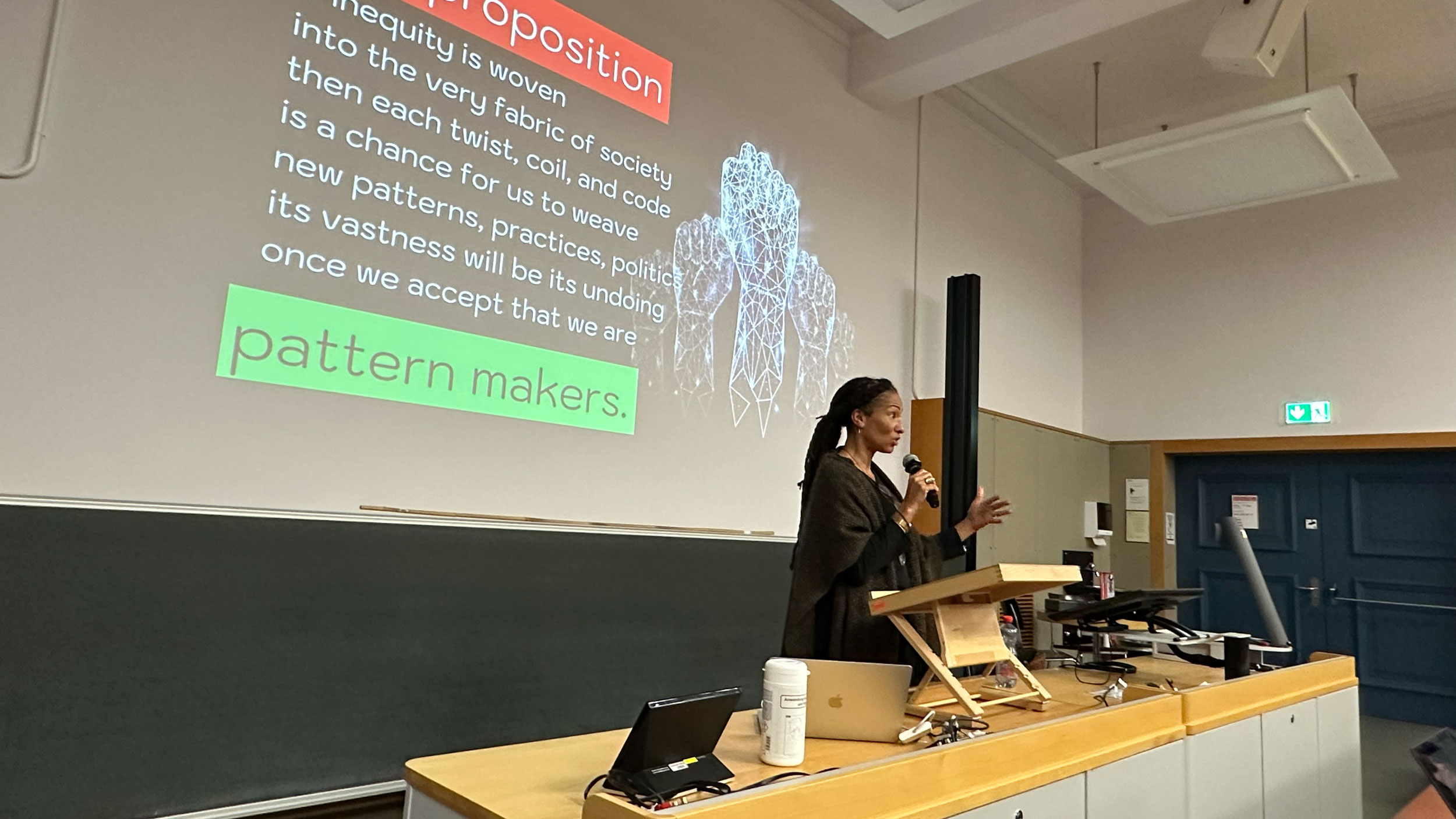
How do modern technologies reinforce racial and social inequalities? How do borders manifest violence? In the foreword of Resisting Borders and Technologies of Violence (Aizeki, Mahmoudi, and Schupfer 2024), transdisciplinary scholar and writer Ruha Benjamin invites us to question and organize against high-tech border imperialism globally.
Benjamin’s euphemism «New Jim Code» refers to the employment of technology that appears progressive or neutral, but actually upholds and perpetuates racism. Using the state-sanctioned violence against Haitian immigrants at the US-Mexican border as an example, she illustrates how national governments increasingly use technology to reinforce xenophobic and racially discriminatory ideologies (Benjamin 2024, XI). While the high-profile spectacle of border violence against Haitian migrants gained global attention, some forms of violence are less prominent (Benjamin 2024, XIII). The digital ID system in the Dominican Republic systematically discriminates against people of Haitian descent living within the country – a technology encouraged by the World Bank and the United Nations (Benjamin 2024, XI).
Benjamin’s work is highly relevant in today’s political landscape. One of Biden’s first executive orders in office was pausing the construction of Trump’s southern border wall. Instead, the White House sent a bill to Congress, calling for the implementation of «smart technology» for border control. It refers to the usage of facial recognition, aerial drones and data fusion centers in border control. In Benjamin’s words, this goes to show how «concrete brutality has been exchanged for covert brutality» (Benjamin 2024, XIII).
To this day, technology is often considered neutral. Benjamin highlights the role of imagination in challenging and reshaping how technology perpetuates inequalities (Benjamin 2024, XI). By examining how emerging digital technologies reinforce existing social, political, and racial disparities, she questions this notion of neutrality. She draws attention to how the digital fortress around the US and the EU upholds imperial structures rooted in white supremacy and global apartheid (Benjamin 2024, XIII). This is where imagination becomes crucial – not just in critiquing current systems but in envisioning alternatives that break free from oppressive patterns (Benjamin 2024, XIII–XIV).
Benjamin emphasizes that it is not enough to simply tweak existing technologies to make them «less biased» (Benjamin 2024, XII). Instead, we need to fundamentally rethink how technology is designed and used to actively dismantle the oppressive structures it currently upholds. Imagination is crucial because it encourages us to think beyond the limitations of current systems and to envision new possibilities for technology. For Benjamin, imagination allows us to ask: What would technology look like if it were designed from the ground up to promote equity and justice? How could digital tools be used to break down borders and foster global solidarity rather than reinforce exclusion and control? (Benjamin 2024, XII–XIV)