On the politics of mask, mirror, modification
An interview with Parvis Ghassem-Fachandi on anti-Muslim Hindu nationalism in India and the role of anthropology
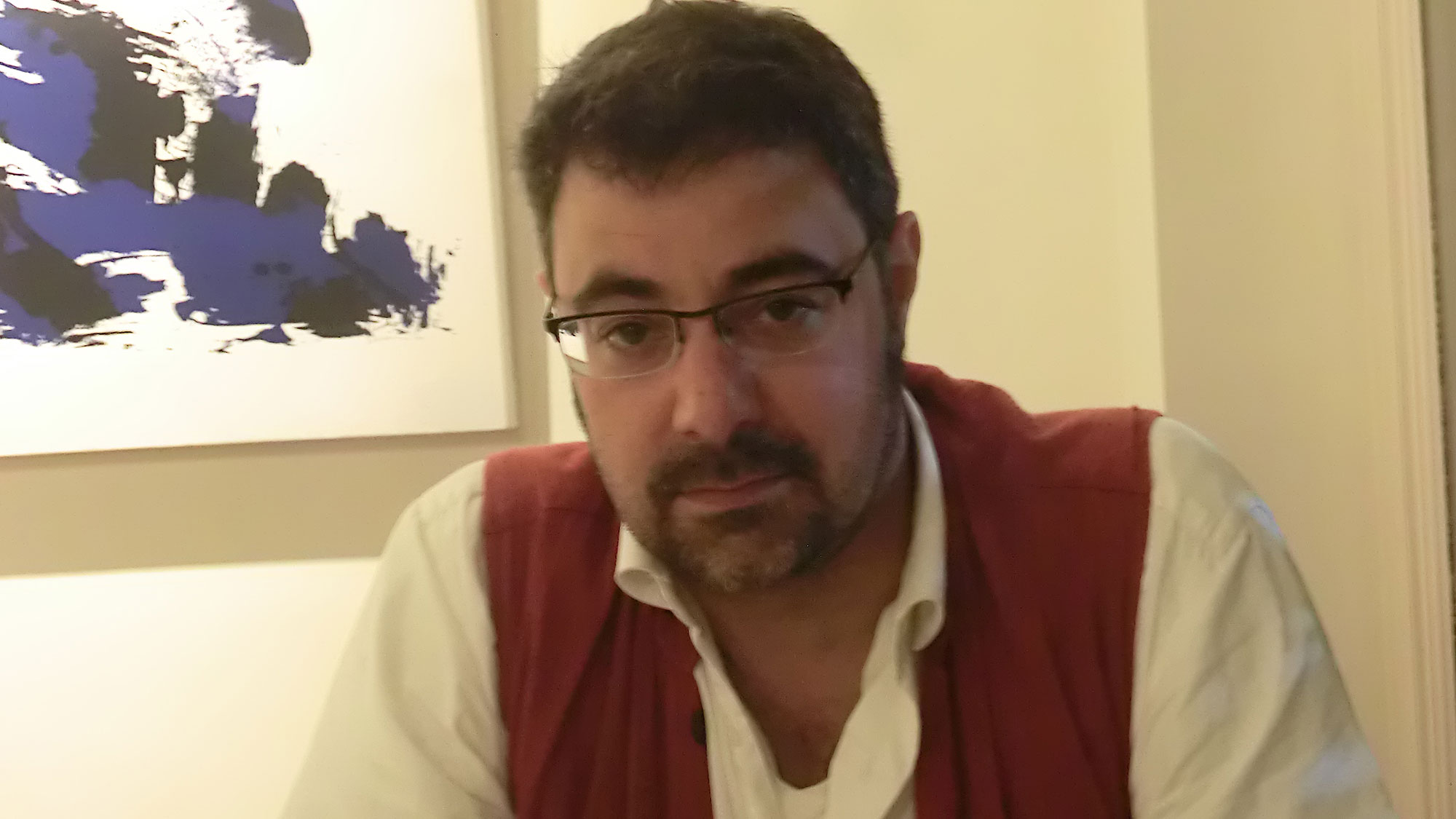
I’ve read that your book Pogrom in Gujarat: Hindu Nationalism and Anti-Muslim Violence in India was not the result of a planned ethnographic research in Ahmedabad, but rather the consequence of “[having witnessed] the bloodshed up close”. Why did you decide to write this book?
Parvis Ghassem-Fachandi:
I don't think that was a decision. Having been trained for years as an ethnographer in Germany and in Cornell University, I knew how to take field notes, how to record, how to observe... I'd been to Gujarat before doing research, and I had already written a whole book on a Muslim shrine in German. I was very well prepared, so when the violence happened, it was obvious that it was my responsibility to document what was happening.
I didn't know that it would come together so easily as a book. You experience discontinuities, contradictions and things you could not immediately understand. Only later, through reflection and analysis, did the meaning of these experiences become clearer.
Ethnographic writing develops through this process. The researcher first experiences and records events, and later interprets them. The final book is therefore not a direct or unprocessed transcription of field notes. It is the result of selecting, organizing, and analyzing experiences in order to make an argument about what happened.
Since the anti-Muslim violent incident in Godhra, the Nanavati-Mehta Commission and the Banerjee Commission have tried to resolve the uncertainty around the case. Even so, both have been, and I quote you, “derided as ‘politically motivated’ by [the] respective opposing political constituencies”.
Parvis Ghassem-Fachandi:
It is difficult to resolve the uncertainty surrounding the violence because Hindu nationalists, in particular the BJP, have gained substantial political power in Gujarat and at the national level. There are competing interpretations of what happened, who was responsible, and how the investigations should be understood. The event has become part of a continuing political struggle over truth, and governments have often used such events for political purposes.
What would be interesting to do now is to go to Gujarat and have a project where you visit the residents of the cities where there had been violence after Godhra, for example, Ahmedabad, from different castes and classes, and talk with them about their memories; going away from the politicization of the event to what people actually remember, and what they say today, twenty years later. Such projects might be politically tricky, as the BJP does not want the truth––it has its own self-serving version of events.
Memory is not preserved only in official archives. Anthropologists are particularly interested in speaking with living people, although memory also changes over time as it passes between generations. The memories of children and grandchildren may differ from those of people who directly experienced an event as adults. These differences are shaped by emotional identification, family narratives, education, and political circumstances.
In the past, you've done ethnographic research in Gibraltar, the US, and Germany. In addition, you have lived as a kid in Canada and France. Taking into consideration this multicultural background, would you say the violence or the hierarchies between Muslims and Hindus are reproduced outside of India? If so, how does this impact people?
Parvis Ghassem-Fachandi:
You can't say that what's happening in India is happening elsewhere. If you go to Pakistan, it's Hindus who are being oppressed as a very tiny minority. They're very badly treated, as are Muslim minorities like Shias or Ahmadis.
You can't replicate that. I don't think you can say that Muslims in the United States are oppressed by Hindus. Maybe in some context you can have the opposite relationship; you can have Hindu workers who are hired to go to the Middle East and who are badly treated by Arab employers.
It would be nice if there were a religion or a nationality that would immunize everyone from being evil, but that is not the case. You always have to look at every national or subnational context again. Who's in control of what? Who owns the means of production of symbolic goods or of material goods? What is at stake? That's what the analysis should show.
What is the focus of your current research?
Parvis Ghassem-Fachandi:
In 2015, I started working on Syrian refugees in Berlin, and have published on relationships between Syrian men and German women. I started that work I part because I began having problems entering India with visas for research maybe because of what I’ve written or maybe because of administrative changes after 2018. You can’t know these things for sure. I’m finishing a book this summer based on research on a Muslim slum, where I describe a Muslim community who is relatively poor and who lives through these years of Modi’s political tenure in Gujarat and then as Prime Minister of India. I describe their everyday life, their conflicts, spirit possession, prayer, class distinctions, caste, etc. That’s my most important project right now.
As a final thought: Why do you think anthropology is important? How do anthropologists contribute to our understanding of the world?
Parvis Ghassem-Fachandi:
I think anthropologists are underestimated because our knowledge is more local and difficult to generalize. We’re not constantly consulted—because we’re naysayers. Dealing with real life and its contradictions, we are less prone (but unfortunately not entirely immune) to engage in the hollow discourse of “expertise.” We usually have counterexamples for every assertion of a state government, administration or an NGO. That said, our knowledge doesn’t need to advertise itself. It’s often useful to not be so visible publicly. It allows you to stay on the ball. I would hope people know that if you live somewhere and learn a language, you have a privilege and you know something about the place.
A lot of people who might not be familiar with anthropology have consulted my book. I think that’s the case with a lot of anthropologists, because we just go very deep into the area we study; we live there, we learn the language, we talk to hundreds of people over a long period of time—one year, two years. I’ve worked for fifteen years in that slum in Ahmedabad, so I have insights that are not necessarily translatable into making money or making political decisions. They are part of a public record of a particular time and place and will often be most useful for future generations.
I think anthropology has an indirect way of contributing. It’s often overlooked because we are very politically left and we are very critical of institutions. It’s a bit checkered with anthropology. I think that’s good that way; if we were really useful to power, we would be co-opted by power. You don’t want to produce truths that are only true because the government wants them to be true. You want to produce genuine knowledge. There is an advantage in being considered irrelevant.
Whereas if you produce uncomfortable knowledge—knowledge where you can’t immediately say, “What’s that good for?”—that is actually a good way to be. Anthropologists go out, learn the language and participate in rituals that are disappearing and, you know, do things that many people say, “What’s that good for?”. I think that’s a strength, not a weakness.
Speaker’s bio
Parvis Ghassem-Fachandi is Associate Professor of Anthropology at Rutgers University. He has engaged fieldwork in India, Germany, the United States and Gibraltar. He is the author of Pogrom in Gujarat: Hindu Nationalism and Anti-Muslim Violence in India (2012, Princeton University Press) and Muslimische Heilige in Gujarat: Sufismus, Synkretismus, und Praxis im westlichen Indien (2008, ECA), and the editor of Violence: Ethnographic Encounters (2009, Berg Press). He is currntly completing a new book manuscript Naming and Omission: Proverbs, Prayer, and Possession in Gujarat. His publications in anthropological journals include Hau: Journal of Ethnographic Theory, Ethnography, Social Anthropology/Anthropologie sociale, Journal of Religious and Political Practice, Zeitschrift für Kulturwissenschaften, South Asian History and Culture, Journeys: The International Journal of Travel and Travel Writing.
Further readings
Ghassem-Fachandi, Parvis. 2012. “‘Why Do You Leave? Fight for Us!’: INCIDENT IN GODHRA.” In Pogrom in Gujarat: Hindu Nationalism and Anti-Muslim Violence in India, 31–58. Princeton University Press. https://doi.org/10.2307/j.ctt7t0nz.5
Ghassem-Fachandi, Parvis. 2012. “Vibrant Vegetarian Gujarat.” In Pogrom in Gujarat: Hindu Nationalism and Anti-Muslim Violence in India, 153–84. Princeton University Press. https://doi.org/10.2307/j.ctt7t0nz.9
Ghassem-Fachandi, Parvis. 2012. “Ahimsa, Gandhi, and the Angry Hindu.” In Pogrom in Gujarat: Hindu Nationalism and Anti-Muslim Violence in India, 185–212. Princeton University Press. https://doi.org/10.2307/j.ctt7t0nz.10