Muslims Laboring for Islam: A Salafi Preaching Community in Niamey, Niger
Conversation with Abdoulaye Sounaye about what it means to work for Islam in Niger
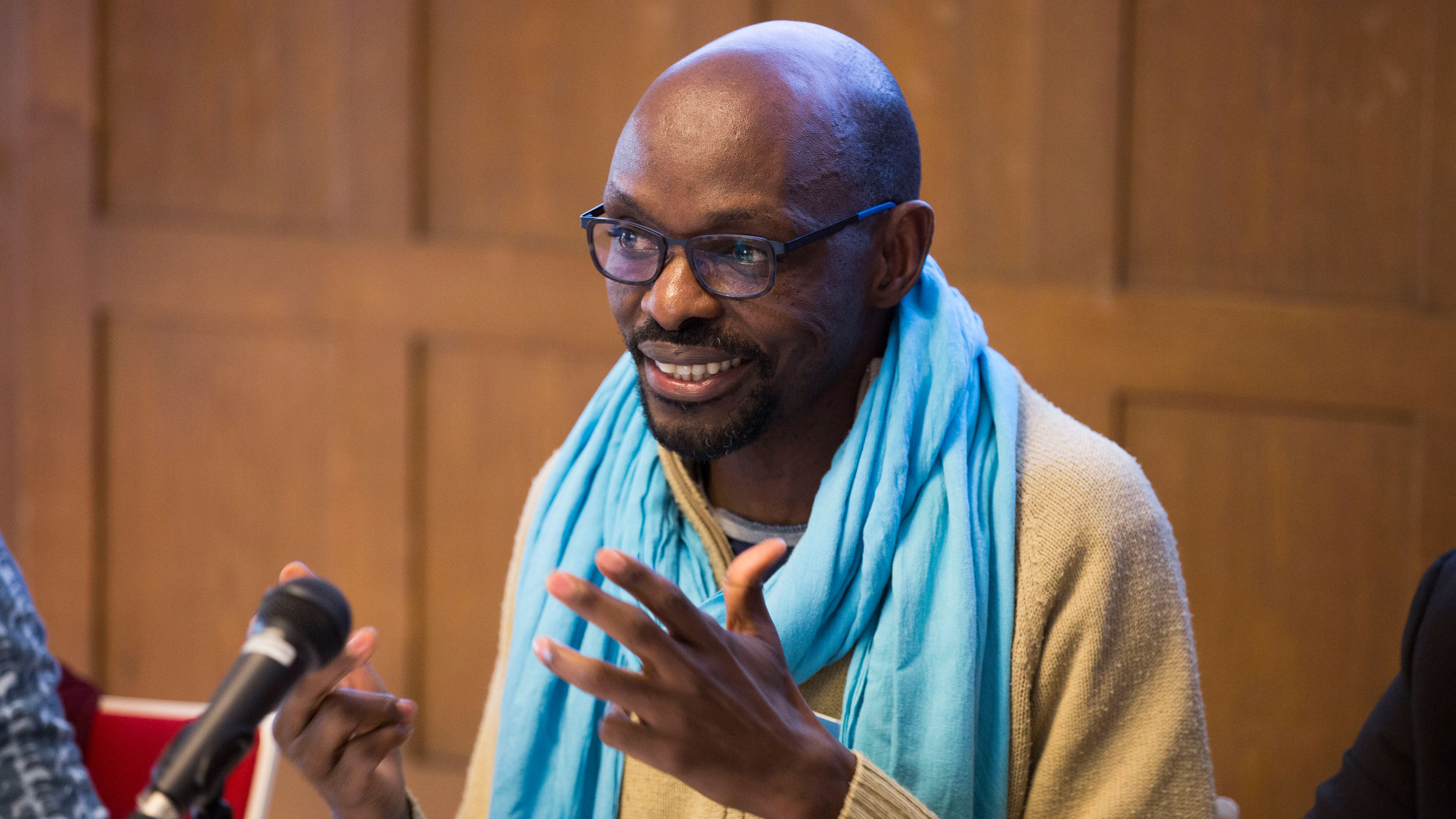
In his recent lecture at the University of Zurich, Abdoulaye Sounaye, a researcher at the Leibniz-Zentrum Moderner Orient (ZMO) in Berlin, shared his ethnographic insights from Niamey, Niger, where he did fieldwork for more than ten years studying a young Salafi preaching community. His talk not only offered vivid insights into everyday religious practice in Niamey but also invited the audience to reflect on how we understand Salafism, and even how we approach the study of religion itself.
The lecture, held on October 7 at ISEK (the Department of Social Anthropology and Cultural Studies), was followed the next day by a one-hour interview in which Abdulaye Sounaye spoke about the Salafi community he studies and his own academic journey. He began by outlining the social background of Niamey and the role of Salafism there, a movement that emphasizes the tradition of the Prophet Muhammad. For the young Salafi community he studies, piety is expressed not only through prayer or preaching but also through labor, discipline, and social organization.
One of the key practices Abdoulaye Sounaye discussed is wazu, a form of collective activity that goes beyond preaching to include bringing people together: audience members, hosts, reciters, patrons, and preachers. Central to this is the Agaji group, a voluntary association whose name, from the Hausa language, means “help,” “assistance,” or “support.” In Niamey’s Salafi context, Agaji refers to a network of young volunteers who dedicate their time and energy to sustaining the community’s religious and social life. The members have different ranks and responsibilities, but they share a common ethic of service and devotion. As Abdoulaye Sounaye explained, “Once an Agaji, always an Agaji.” The phrase aikin adini, literally “working for religion” in Hausa, captures their sense of commitment: it is both an identity and an ethic of labor and dedication.
During our interview, Abdoulaye Sounaye elaborated on how he views the young people who join the Agaji. Membership can be competitive, joining requires commitment and discipline, but once inside, members often describe the group as a second home. This topic can also be sensitive, as similar organizations elsewhere in Africa have drawn suspicion. In Niamey, however, Abdoulaye Sounaye’s research suggests something different. Many young people are indeed exposed to various movements that seek to mobilize or influence them, but the Agaji members he studied are guided by a very different spirit: their work aims to transform society gradually, through discipline, service, and moral reform rather than political rebellion. In this sense, the Agaji embody a vision of social change rooted in moral reform and communal care rather than political rebellion.
Beyond these ethnographic insights, Abdoulaye Sounaye also reflected on what it means to study religion anthropologically. He observed that research on religion often becomes “too religious” in its focus, forgetting that every scholarly method is itself just one possible lens. “Let’s not forget,” he reminded us, “this is just an approach, just a perspective.” Developing such reflexive awareness, he argued, allows scholars to recognize other dimensions of the social realities they study and to remain humble about the limits of their own frameworks.
Expanding on this more sociological or even interdisciplinary approach, Abdoulaye Sounaye views the Agaji as a powerful example of resourcefulness. The wazu space itself, he emphasized, is a social resource, a place where young people learn to “engineer” opportunities in a context of scarcity. “If there are no resources,” he explained, “you have to create them. You have to create that social space where you help each other, where you find a way to acquire the discipline you need to succeed in school or in business.” In this way, the Agaji demonstrate that religion is not only a site of devotion but also a form of social engineering: a collective effort to build networks, skills, and moral capacities that enable survival in a post- or neo-colonial society struggling with the remnants of disempowering dependency relationships. Their creativity shows how faith can become a practical means of “making do” within structural limits.
Abdoulaye Sounaye’s reflections remind us that to understand Salafism, or any religion, we must look beyond texts and doctrines to the everyday practices that make faith tangible. For the Agaji, “working for Islam” is not simply about conforming to rules; it is about creating spaces of belonging, mutual support, and self-discipline in a challenging urban environment. In this respect, his work challenges us to reconsider religion, not as a mere belief system, but as a source of agency, social creativity, and moral labor with the potential to transform society for the better.