Lehrstuhl Ökonomische Anthropologie
Neugier und Empathie sind zwei wesentliche Eigenschaften ethnologischer Denkweise: Neugier über die faszinierende Vielfalt menschlicher Erfahrungen und kultureller Ausdrucksformen in der Welt; Empathie mit all denen, die ein Leben voller Unsicherheit und Marginalisierung führen mit wenig Perspektive, sich und ihren Familien eine nachhaltige Zukunft zu sichern. An unserem Lehrstuhl streben wir eine Ethnologie an, die diese beiden Eigenschaften nutzt und sie wissenschaftlich weiterentwickelt, Grundlagenforschung und Theoriebildung mit aktuellen Fragestellungen in einer sich rasch wandelnden Welt verbindend. Dabei verfolgen wir einen kritisch-realistischen Ansatz, der auf der Annahme beruht, dass wir mit den richtigen Methoden und Theorien in der Lage sind, einige der grundlegenden Muster und Kausalitäten aufzudecken, die unser Leben in einer global vernetzten Welt prägen.
Forschungsthemen und Regionen
Zwei thematische und ein regionaler Schwerpunkt prägen die Arbeit des Lehrstuhls, wobei dies weitere Schwerpunkte in den Forschungen keineswegs ausschliesst. Einer dieser Schwerpunkte liegt auf Prekarität und Opportunität, in dem wir Prozesse des wirtschaftlichen und sozialen Wandels untersuchen und wie diese zu einer ungleichen Verteilung von Ressourcen, Chancen und Vulnerabilitäten unter verschiedenen Gruppen und einzelnen Akteuren führen. Der zweite Schwerpunkt befasst sich mit der Beziehung zwischen Kultur, Kognition und Gesellschaft, oder der Art, wie Modelle der Welt und über die Welt von sozialen Beziehungen und institutionellen Konfigurationen geprägt werden und diese wiederum beeinflussen.
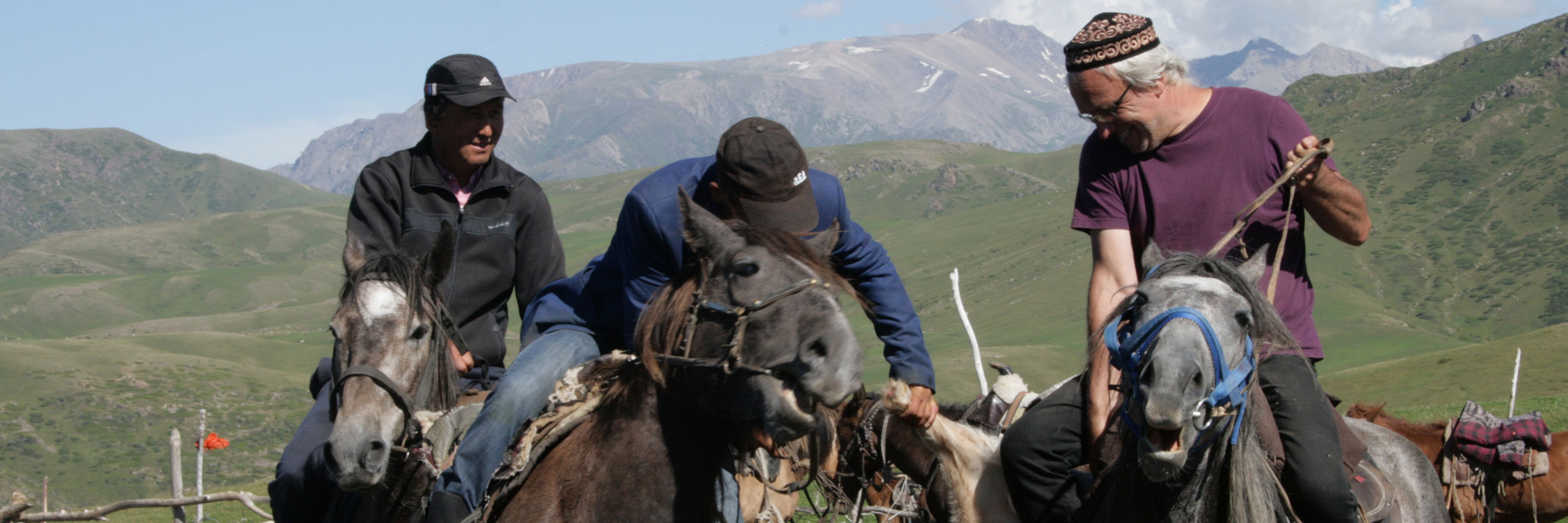
Ein grosser Teil der Forschungsarbeit unseres Lehrstuhls findet in Zentral- und Innerasien statt, wo Prozesse des wirtschaftlichen und sozialen Wandels seit dem Ende der sozialistischen Regime besonders ausgeprägt und sichtbar sind. Darüber hinaus gibt es Projekte zu anderen Teilen der Welt, darunter Europa, Lateinamerika und dem Nahen Osten, sowie zur Vernetzung von Orten und Menschen weltweit durch wirtschaftliche Beziehungen, Migration und kulturellen Austausch.
Projekte
Enabling Transformative Actions to Leverage Sustainability of Eurasian Grasslands: ActSustainably (SNSF: Biodiversa+; 2026-2029)
https://data.snf.ch/grants/grant/232928
SOCIAL: Sociology of Authoritarian Law: Insights from Central Asia (Horizon-MSCA-2024 Doctoral Network; 2026-2029)
https://cordis.europa.eu/project/id/101226419
POLCA: The Political Economy of Legal and Governance Reform in Non-Western Societies: Insights from Central Asia (Horizon-MSCA-2024; 2026-2029)
https://cordis.europa.eu/project/id/101228676
Dealing with Institutional Volatility: Food Production, Processing and Trade in South-Eastern Qazaqstan (SNSF; 2025-2029)
https://data.snf.ch/grants/grant/10003314
Biocultural adaptation of resource management traditions under the effects of climate change (Belmont Forum; 2024-2027)
https://data.snf.ch/grants/grant/222651
MARS: Non-Western Migration Regimes in a Global Perspective (Horizon-MSCA-2022; 2024-2028)
https://cordis.europa.eu/project/id/101130177
MOCCA: Multilevel Orders of Corruption in Central Asia (Horizon-MSCA-2021; 2023-2026)
https://cordis.europa.eu/project/id/101085855
Abgeschlossene Projekte
Central Asian Law: Legal Cultures and Business Environments in Central Asia (Horizon-2020-MSCA-Rise; 2020-2024)
https://cordis.europa.eu/project/id/870647
HumMingBird: Enhanced migration measures from a multidimensional perspective (Horizon-2020-SC6; 2019-2024)
https://cordis.europa.eu/article/id/444860-a-data-driven-approach-to-the-migration-challenge
Dealing with Uncertainty: Changing Strategies, Institutions and Perceptions among Pastoralists in Western Mongolia (SNSF 2014-2017)
https://data.snf.ch/grants/grant/149357
Ethnic Differentiation, Interethnic Relations and Conflict in Central Asia: The Case of the Uzbeks in Kyrgyzstan, Afghanistan, Tajikistan and Kazakstan (SNSF/DFG; 2013-2016)
https://data.snf.ch/grants/grant/140434
Development and Trust in Upper Mesopotamia – The Social Impacts of GAP (SNSF; 2012-2016)
https://data.snf.ch/grants/grant/137795
Team
Peter Finke, Lehrstuhlinhaber
Désirée Gmür, wissenschaftliche Mitarbeiterin
Werner Hertzog, wissenschaftlicher Mitarbeiter
Iuliia Koreshkova, Assistentin
Meltem Sancak, Oberassistentin
Michelle von Dach, Oberassistentin
Doktorierende
Mustafa Akcinar
„Understanding the Influence of the Ilisu Dam Project for local people in Hasankeyf in the context of uncertainty, risk and contingency”
Rūta Dapkūnaitė
„Local Cultural Models and Varying Responses Towards Immigrants: An Anthropological Analysis of Acceptance and Resistance in Lithuania”
Dilafza Haydaraliyeva
„The Local Lives of Built Heritage: Community Perspectives on Archaeology, Conservation, and Identity-Making in Post-Soviet Uzbekistan”
Aliya Kashaganova
„Smallholders and Petty Agricultural Producers in the Zhetysu Region”
Munkh-Ochir Surenjav
„Local Democratic Practices and Everyday Governance in Rural and Peri-Urban Mongolia: Civic Participation, Traditional Authority, and Institutional Adaptation.“
Gulnaz Tulenova
„Food Processing, Risk and Institutional Volatility in South-eastern Kazakhstan“
Yelif Ulagpan
„Pasture Governance and Rural Democratization: A Bottom-Up Analysis of Everyday Politics and Local Decision-Making in Post-Soviet Kazakhstan.“
Georg Winterberger
„Beyond Livelihood Strategies: Change, Decision-making Process, and Innovation in Myanmar Society“
Abgeschlossene Dissertationsprojekte
Michelle von Dach
„Italy as a Migration Hub towards Europe“ (2026)
Huajing Yang
„Community Interaction and Identity Attachment in Transnational Mobility Contexts, Dependent Echoing and Dynamic Transitions: A Case Study of Uzbek Communities in Germany and Social Transformation in Post-Soviet Uzbekistan“ (2026)
Dinara Abildenova
„Celebrations in Qazaqstan: Social Norms and Their Change“ (2023)
Indira Alibayeva
„Uzbeks in Qazaqstan: cultural models of ethnicity, navigating ethnic differences and pathways of adaptation“ (2023)
Tara Bate
„ Pastoralism without Herders in Limi, Nepal “ (2023)
Verena La Mela
„Solidarity in competition: Women, trade and social networks in south-eastern Qazaqstan“ (2023)
Zarina Mukanova
„Kinship and gender in patrilineal descent in rural area of South-Eastern Kazakhstan“ (2023)
Tabea Rohner
„The Edible Monotown: Gardening, Foraging and Human-Environment Relations in (Post)Industrial Kazakhstan“ (2023)
Hatice Söylemez
„Is Another School Possible? Rethinking Alternative Education in Turkey: The Case of BBOM Democratic Schools“ (2023)
Dominik Müller
„Negotiating Islam in the turkish community outside of Turkey: an anthropological perspective on Diyanet in Switzerland“ (2022)
Annelies Kuijpers
„Suddenly You Realize You are Living in a Hidden Paradise. Branding tourist space in Halfeti Turkey (an ethnographic study on destination branding)“ (2021)
Daniela Dietz
„InDifference: Living together (apart) in a Turkish urban neighbourhood“ (2019)
Linda Kelley
„Dealing with Uncertainty: Changing Strategies, Institutions and Perceptions among Pastoralists in Western Mongolia“ (2019)
Jovana Dikovic
„Post-socialist rural development and peasantry in Serbia“ (2018)
K. Zeynep Sarıaslan
„Housewives ‘in Progress’: Persistence of Turkey’s Gender Regime in the Context of Development“ (2018)
Eliza Isabaeva
„Migration into 'Illegality' and Looking Like the State in Post-Soviet Kyrgyzstan“ (2017)
Christopher Kelley
„Building Power. Trade Union Renewal in the Changing Swiss Construction Industry“ (2017)
Esther Horat
„Market Transformation and Trade Dynamics in Northern Vietnam: The Case of Ninh Hiep“ (2016)
Stefan Leins
„Cockpits of Capitalism: An Ethnography of Financial Analysis“ (2015)
Alessandra Pellegrini
„Becoming a Peasant Middle Class: Coca Growers and the Politics of Indigeneity in the Bolivian Yungas“ (2013)
Dilyara Suleymanova
„Schooling the Sense of Belonging: Identity Politics and Educational Change in Post-Soviet Tatarstan“ (2013)
Irina Wenk
„Ancestral Domain: Land Titling and the Conjuncture of Goverment, Rights and Territory in Central Mindanao“ (2012)
Ko-Betreuung von Doktorierenden
Pan Hongjin (U Heidelberg)
„Digging down and growing up: A Study of Mine Pits Reclamation on the Sino-Mongolia Border“ (on-going)
Yue Jiang (UZH, ISEK)
Nadia Kempter (UZH, ISEK)
„Research about high-tech processes in agribusinesses in Vietnam“ (on-going)
Daniel Repky (UZH, ISEK)
„Ludi imaginationes? Eine antithetische Konfiguration stochastisch probabler Responsen Artifizieller Intelligenzen und der Epistemologie fiktionalisierter Sozialrealität in der westafrikanischen Weissagungspraktik“ (on-going)
Aida Alymbayeva (Martin Luther University Halle Wittenberg)
„Contesting Kalmak Identity in Contemporary Kyrgyzstan“ (2021)
Juliane Neuhaus (UZH, ISEK)
„It Takes More Than a Village Court: Plural Dispute Management and Christian Morality in Rural Papua New Guinea“ (2020)
Aliya Khawari (Universität Zürich, Institut für Politikwissenschaften)
„The Political Economy of Microfinance“ (2015)
Danae M. Perez Inofuentes (Universität Zürich, Englisches Seminar)
„From “Gringo” to “Guarango”: Language Shift in a Former Anglophone Community in Paraguay“ (2015)
Soledad Jiménez Tovar (Martin Luther University Halle Wittenberg)
„Centripetal Mirrors: Cultural Conservation among Shaanxi Dungans in Kazakhstan“ (2014)
Philipp Schröder (Martin Luther University Halle Wittenberg)
„Bishkek after or before the Revolution? Integration, Conflict, and Identification among Youth in a post-Soviet Urban Context“ (2012)
Aksana Ismailbekova (Martin Luther University Halle Wittenberg)
„Patron-Client Relations within the context of a Kyrgyz community“ (2011)
Rita Sanders (Martin Luther University Halle Wittenberg)
„Why Did They Stay Behind? Identities, Memories, and Social Networks of Kazakhstani Germans“ (2010)