
Service-learning has become an integral part of university curricula in North America as well as other places in the world. It is a form of experiential learning that combines community needs (volunteering) with subject learning (usually in the classroom). While service-learning can take many different forms, its main features can be described with four Rs: reality, reciprocity, reflection and responsibility (Godfrey et al. 2005). This means that – ideally – service-learning projects are linked to real, concrete problems in the community; the relationship takes the form of a mutually beneficial partnership; and experiences are reflected deeply and linked to broader societal concerns following a social justice orientation.
Varying from one-semester courses to long-term campus–community partnerships, service-learning aims to develop skills for sustainable transformation. Students’ immersion in service-learning projects should provide a special training ground for reflecting on one’s own and others’ values underlying actions, benefiting from an understanding of learning as a collaborative endeavour, and developing capacities as creative and holistic actors while navigating in complex fields (for competencies see Wiek et al. 2011).
In Switzerland, service-learning is a relatively new technique. In 2020, the Swiss Network for Service-Learning at Higher Education Facilities, ben:edu, was founded. In 2021, the UZH Teaching Fund (ULF) financed a two-year project for the development of a service-learning offer. This project, led by Rivka Eisner and me, was the first service-learning initiative at the University of Zurich. Since 2023, the service-learning approach is also the basis of “Mentoring for the Next Generation”, a joint module between psychology, economics and sociology.
In the following, I reflect on the experiences with the two distinct service-learning modules that we developed in the framework of the ULF project: “Soziales Engagement im Studium” (Social Engagement in / under Study) in spring semester 2023 and “Zur glücklichen Zukunft – Ethnologie, Engagement, Zürich” (Towards a Happy Future – Anthropology, Engagement, Zurich) in spring semester 2024. While the modules did not attract a lot of students, those who booked the courses were highly motivated to engage in community service, use their knowledge to give something back, work on a topic of their interest and reflect on their experiences in the protected setting of a university classroom. Both courses started with discussions of literature on engaged scholarship in general and approaches to service-learning in particular. Later reading was more specifically aimed at contextualising the respective service-learning projects.
The first course, “Soziales Engagement im Studium”, had an open format. Although I had made contacts with potential local practice partners, students were free to arrange their own community partner. All students ended up choosing to engage in German language lessons: one in a community centre, others by partnering with a refugee. They signed volunteering agreements which stipulated, among other things, that sensitive information about the tandem partners should not be passed on and that differences in economic resources should be handled carefully, e.g. the more privileged student should not be invited out for coffee by her partner.
Students were required to volunteer for 30 to 45 hours. In addition, they had to fulfil several in-class assignments, such as keep a learning journal, select a text for a session that would put aspects of their engagement into a larger context, and reflect on their experiences in the form of a final report.
What may look like a simple community service practice quickly turned out to be a complex, even complicated matter. There was a lot more at stake than simply teaching German: more needs, more expectations and more responsibilities. For example, joint activities did not “only” centre around language fluency, but also included opening a bank account, aiding with computer skills such as using e-mail and PDFs, practicing driving a car and searching and applying for apprenticeships. Although tandem partners were entitled to access these kind of support services through social assistance and coaching programs, they were hesitant to turn to local authorities and felt more at ease with their student tandem partner. While this provided interesting insights into the support system for migrants and refugees, it also raised questions about the scope of service-learning. Students reported how they at times felt overwhelmed and wondered how they, as laypersons, could navigate the administrative jungle that is normally the terrain of trained social workers. Navigating this complexity was challenging and involved communication and emotional processing on all sides.
Also, other expectations and needs turned out to be far from straightforward, some of which had to do with our ideas of engagement (and its – somehow – counterpart: detachment, see Candea et al. 2015). Our in-class discussions repeatedly revealed that we had imagined our engagement as having to do with feelings and practices of closeness, empathy, equality, and transparency. Yet, students struggled with the impression of not being able to make “real” contact, that engagement in practice felt vague and undefined. Moreover, while students were well aware of their privileges in terms of language, local knowledge, financial and civic security, other types of resources and differences turned out to play a more important role for their tandem partners, such as access to particular social networks and having a child or not. Similarly, the rule of strictly avoiding costly invitations, such as for a coffee, turned out to be somewhat at odds with the desire to meet each other on equal footing. In short, we had clearly entered an area of tension.
As time went on, many things became more and more tangible. However, this process outlasted the first semester in which most of the meetings took place in the classroom. The reflection reports submitted at the end of the second semester show how the emotional involvement fertilised and enriched the critical attention and discussion of genuine ethnological and ethnographic issues. In the reports, the students describe in differentiated ways how they have learned to listen to needs, build relationships, recognise boundaries, deal with frustrations and differences, and put some of these into perspective. They refer to their anthropological training and identify it as a resource. It was a moving experience for all of us.
The second module of the UZH Teaching Fund project, “Zur glücklichen Zukunft – Ethnologie, Engagement, Zürich”, was based on a pre-defined service-learning project. Our partner was the Library for a Happy Future association, which had organised events and exhibitions in the Klimapavillon on Werdmühleplatz the previous year, in which Zurich residents had created visions of a good future life in the form of texts, picture collages and small handicrafts. The library team was preparing to develop this work further in a national action research project and needed an overview of the data (visions) collected in Zurich. This was where our service came in. The library’s needs related well to scholarly activities we learn and teach at university: analysing material, looking for patterns and blind spots, and placing discussions in a broader context (in this case, relating it to questions of well-being and possible, plausible or desirable futures). We also imagined feeding some of these visions back to the city of Zurich, perhaps in the form of a podcast in which we would discuss questions more deeply, stimulate thought and action, seek dialogue and make recommendations based on our exploration of the topic.
Instead of meeting in class, we met for eight days in the library director’s studio in the centre of Zurich. She showed us the visions of the future stored in 140 jars and spread on the floor, grouped into themes such as Ways of Life in the Future; Housing, Energy and Green Spaces; and Consumption, Sufficiency and Circularity. She also gave us access to audiovisual documentations, the visitors’ data sheets with some personal details, and the guest book entries.
As we set to work to analyse and synthesise the data, we found that the visions painted a fairly uniform picture. In a nutshell, the future good life is one of collectivity, connection and harmony. Artificial intelligence takes over tedious work while people meet in cooperative living spaces or in the many green spaces of the city of the future (meadows, community gardens, eco-courtyards or under one of the numerous trees) to share and repair. Energy is from green sources. The air is filled with birdsong instead of traffic noise – people mainly cycle rather than drive cars. This is not presented as an effort; with slowness and frugality comes ease.
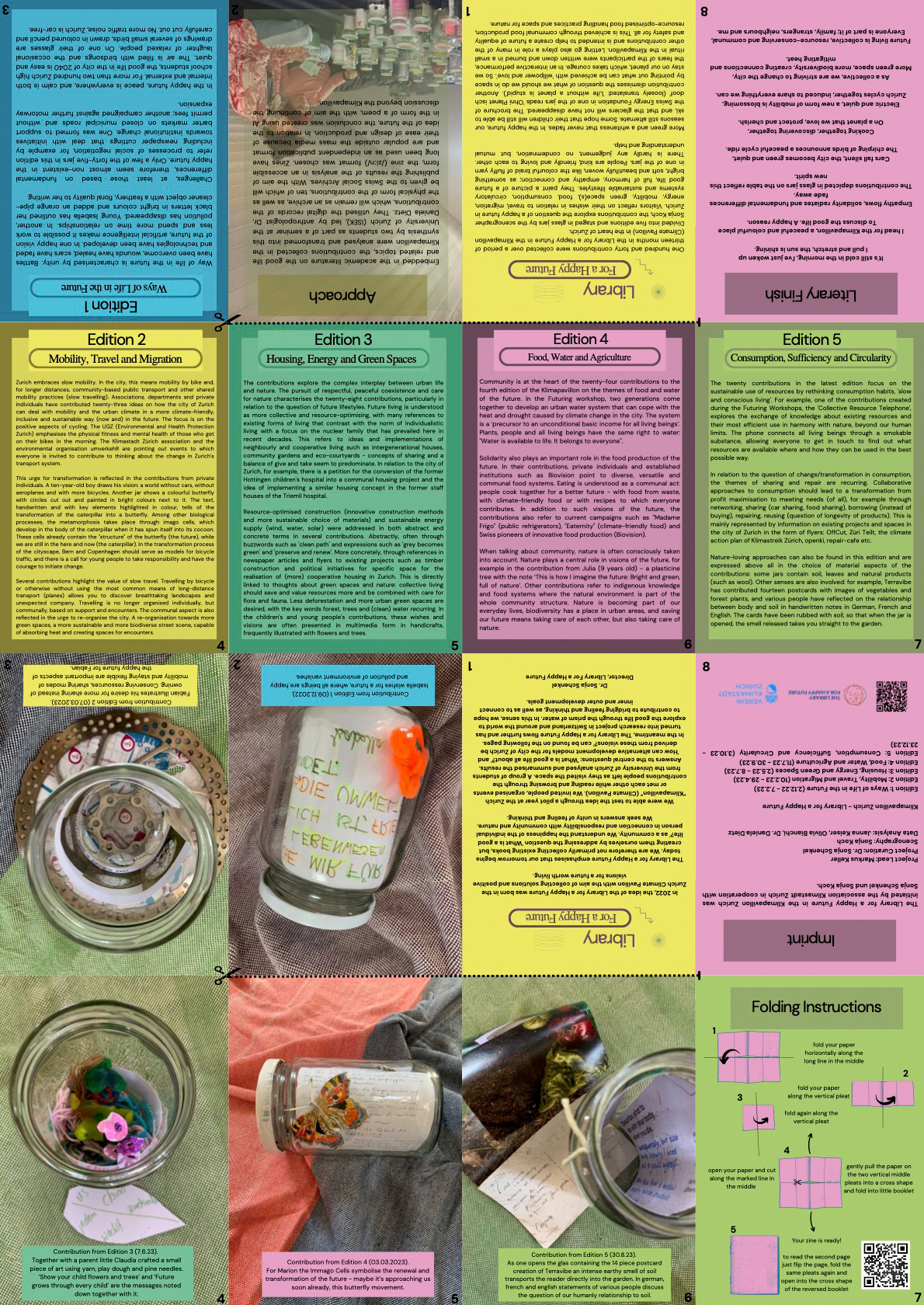
In contrast to the previous service-learning seminar, there were no ethical concerns with regard to transparency. We had the opportunity to discuss the form and content of the service on an ongoing partnership basis, as the library director was usually present and we all shared linguistic and educational (anthropological) backgrounds. And so the students’ own initiatives fell on fertile ground. For example, after finishing the synthesis as a PDF, they took the time to spend a class-free weekend converting it into a zine (see picture above). This form of publication is particularly common when people are unwilling or unable to use official channels of communication and are trying to establish a personal and horizontal exchange. The zines are now passed from hand to hand at library events, which fits in well with the library’s approach to creating tangible experiences.
But when it came to our service ‘to the city’, there was no end product in sight. We had immersed ourselves in the visions and came back with many questions. What kind of visions do we have before us? Expressions of expectation, hope, speculation? What do they feed on? And do they motivate people’s actions? How are these stories and images connected to life? And why are they so similar (and so familiar) and so static? Where are ideas or concepts of difference and change? Our anthropological training obviously fuelled our curiosity and turned our service-learning project into an exploration. As in our previous service-learning course, this one also extended beyond the one-semester format.
We started to record voices but without wanting to impose our recommendations for a positive future for Zurich, without feeling entitled to draw any conclusions yet. Rather, the recordings are of conversations about our questions with some of the creators of the visions whom the students had contacted. It was these encounters that students reported as particularly valuable learning experiences.
As service-learning is gaining momentum, it is important to reflect on first experiences and consider possible caveats. Indeed, learning outcomes are by no means certain. Service-learning is a highly context-sensitive endeavour that may involve undesirable learning experiences for both the participating students and the community involved. Unless carefully embedded, service-learning projects run the risk of creating frustration and narrow-mindedness rather than contributing to understanding of complexity and experiences self-efficacy; of perpetuating asymmetries instead of building reciprocal relations; of individualising needs instead of promoting social justice.
The first module was more challenging in this respect. There were moments of strain. We struggled with problematic aspects of the service concept (see Mitchell 2008), and embedding the experience in structural contexts was as urgent as it was difficult due to the immersion in dyadic relationships. In this sense, however, it also showed more potential than the second module in terms of transformative learning. Although learning outcomes are notoriously difficult to assess in the long term, theories of transformative education emphasise not only the importance of holistic and situational learning in dealing with complexity, but also the value of disruptive experiences. At times, the very ambivalence of “service” called for a deep examination of ourselves and the world with us.
University curricula in other parts of the world show that service-learning can make fruitful links with all disciplines. Our two modules related to the social anthropology programme in different ways. While the second one was more about the application of general academic skills, some situations in the first module resembled those of fieldwork. It is no surprise, then, that some authors argue that service-learning and anthropology are strikingly related because of the ethnographic component and the exposure to unfamiliar lifeworlds that pose specific logistical, ethical and analytical challenges (Keene & Colligan 2004).
Beyond the question of inherent disciplinary proximity and in the sense of a provisional conclusion, the wider implementation of service-learning at the university would be timely and enriching. It is not just a complement to approaches that develop their starting point from theoretical gaps, but a much more far-reaching exercise. Starting from the needs (not wants) of those affected, learning from these concerns through dedicated work, and developing further questions on the basis of these experiences hold unique potential for learning to work for what many say really matters.
Sources
Candea, Matei; Joanna Cook; Catherine Trundle and Thomas Yarrow (eds.). 2015. Detachment. Essays on the Limits of Relational Thinking. Manchester: Manchester University Press.
Godfrey, Paul C., Louise M. Illes and Gregory R. Berry. 2005. “Creating Breadth in Business Education through Service-Learning,” Academy of Management Learning & Education 4(3): 309–323.
Keene, Arthur S. and Sumi Colligan. 2004. “Service-Learning and Anthropology.” Michigan Journal of Community Service Learning 10: 5–15.
Mitchell, Tania D. 2008. “Traditional vs. Critical Service-Learning: Engaging the Literature to Differentiate Two Models.” Michigan Journal of Community Service Learning, 50–65.
Wiek, Arnim; Lauren Withycombe and Charles L. Redman. 2011. “Key Competencies in Sustainability: A Reference Framework for Academic Program Development.” Sustainability Science 6: 203–218.