
Horrifying incidents of sexual violence against women have been occurring in India recently. A quick scan of news reports shows their frequency: on 8 August 2024 a Dalit woman was gang-raped and mutilated. On the same day, a trainee doctor was gang-raped and murdered. The day before, an Adivasi[1] woman was allegedly gang-raped. The day later, a government employee raped a 6-year-old Dalit girl and threatened her not to report the crime. A few days later, the chief physician of a private hospital raped a Dalit nurse. A week later, a 4-year-old Dalit girl was raped and in critical condition at a hospital, and a 27-year-old Adivasi woman was raped on the day of a religious festival. The list goes on.
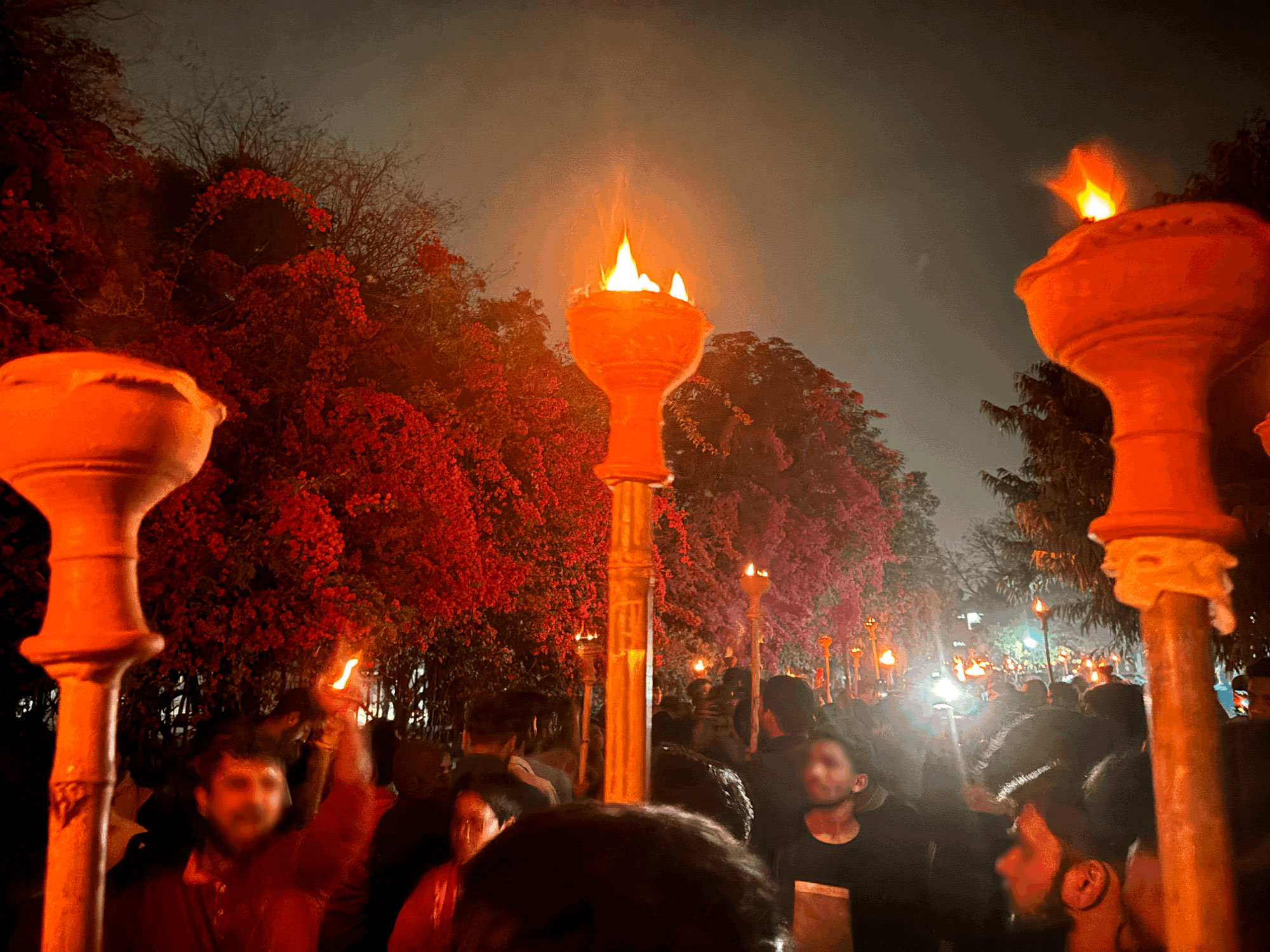
However, out of the cases above, only one sparked nation-wide outrage, that of the trainee doctor. Many large-scale multiple waves of protests and marches were held in response to the case of rape and murder of the trainee doctor. Without question, the crime itself is heinous. Yet the distinct public reaction only to this particular case uncovers complex issues of marginality and identity in South Asian society. It is important to ask few questions here. When do feminists take to the streets in India? Which incidents stimulate large-scale protests against crimes against women? The answers can vary but are complex, versatile and layered.
Who is to be saved first?
On 17th September 2024, as the trainee doctor case was being discussed in the Supreme Court of India, lawyers raised concerns about protecting the identity of the victim, specifically regarding the circulation of the victim’s name and image on the internet. While it is important and moral to uphold the confidentiality of the victim’s identity, disturbing realitites unfold from when one looks for example, at a horrific incident which happened few months earlier, highlighting a stark contrast to a previous instance. A video showing two Adivasi women from Manipur, being paraded naked by a mob, went viral. In the video, one could see the two Adivasi women being stripped, assaulted, grabbed by their private parts and dragged violently from a road to a field. Shockingly, no police action was taken for 14 days after the incident took place, and the state’s chief minister mockingly demanded proof of the alleged rape. The Court formed a committee to investigate the matter only three months later, and the footage still continues to circulate online.
In this distorted social hierarchy, the suffering of Dalit-Adivasi women goes beyond mere invisibility; during legal prosecution it is systematically erased and silenced, trivialized by the indifference of those who benefit from the existing social order[i]. The cases of Dalit-Adivasi women become only little more than a statistic in crime reports or a footnote in the scholarship of caste-based violence.
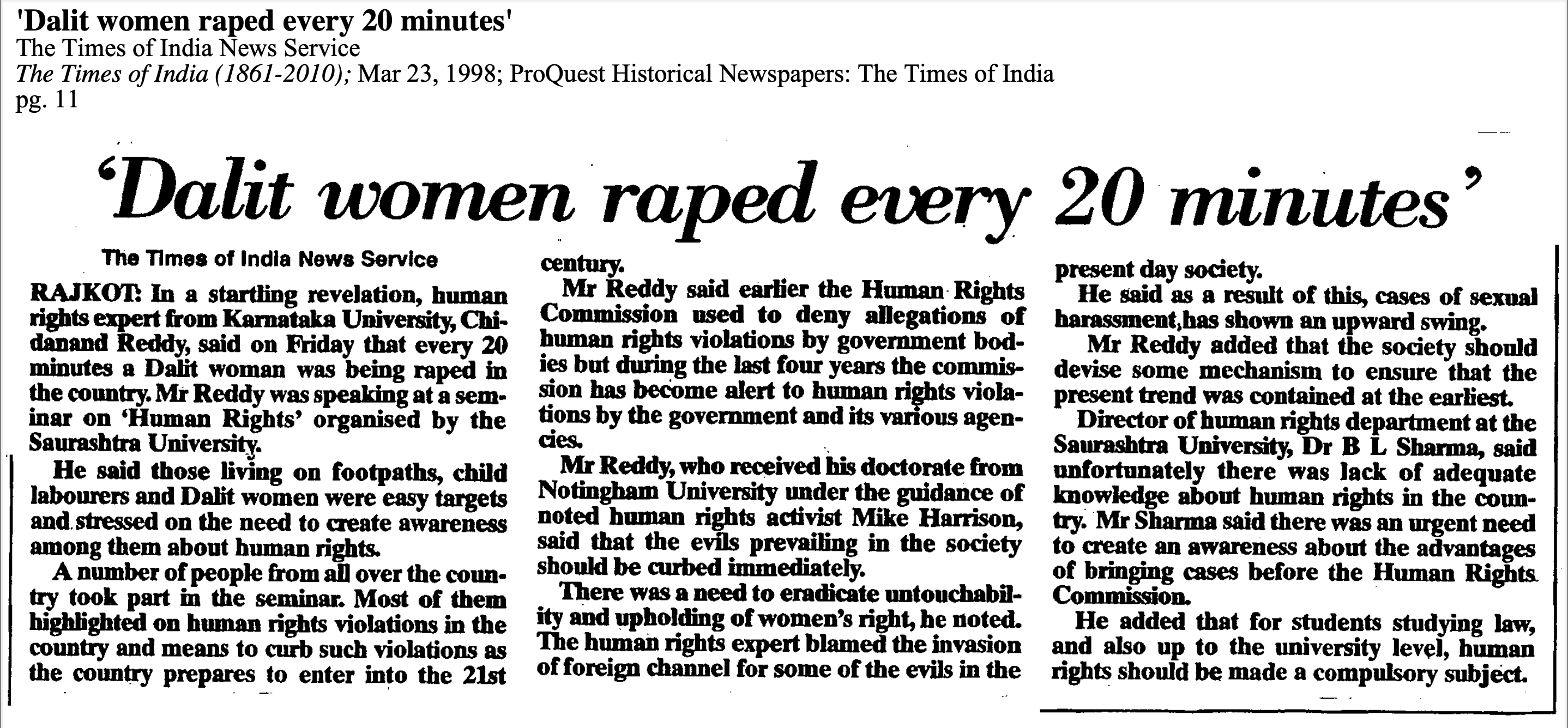
While caste-based sexual violence is not a new phenomenon, it is an issue that can be traced through the historical archive[ii] as well as recent statistics from the National Crime Records Bureau (NCRB), which only further highlight the gravity of the situation. Despite the glaring omission of henious crimes against these women in the criminal justice system, the statistics still show a significant rise in these cases. From 2016–21, the statistics highlight the systemic and structural nature of violence where the rape cases of Dalits have increased to 7.64 percentage and of Adivasis to 15 per cent. The NCRB also reports details of rape, murder, assault, and kidnapping cases which increase by 16.8 and 26.8 per cent, respectively.[iii] Even in the presence of such imcomplete data and in the absence of true data, one can surmise the true extent of caste-based sexual violence.
Who Does Law and Society Support?
Around 50 Dalit families are currently facing social boycott in their district of residence because they refuse to withdraw charges of sexual assault of a Dalit girl.[iv] Despite laws stating otherwise, identity influences citizenship but also the pursuit of justice in India. The Constitution of India has guaranteed equality for all its citizens and protection of Scheduled Castes and Scheduled Tribes[2][v], but unequal social positioning endures in people’s perception, influencing every contact, engagement and action between groups.
For those left to suffer in silence and those being socially boycotted, the justice system mostly remains inaccessible and with the added susceptibility of more crime. Many times, fear and social stigma prevent cases from being reported to the police in the first place. Even if reported, chances are high that police officers, who are often from upper caste male backgrounds, will protect the criminals in lieu of supporting the victims.
The sexual violence against Dalit-Adivasi women is a grave human rights violation and often an attempt to dishonor and terrorize minority communities.[vi] It symbolizes not just sexual misconduct but identity-derived biases. Upper caste men take advantage of the societal vulnerability of Adivasi women without any fear of social stigma or consequences, as the justice system often turns a blind eye to them. This highlights the broader failure to reverse societal apathy towards Dalit-Adivasi women, who routinely suffer from minimization and being discounted. These biases are also diffused into the justice system of the country.
Where is the mainstream media?
Recent social media hashtag trends, such as the “let us not forget the Doctor’s rape” thread, underscore the powerful influence of identity in public discourse, where the act of remembering also serves to perpetuate an event’s societal impact. First Minister of Law and Justice BR Ambedkar had long argued that “the Untouchables have no press”.[vii] This is exemplified by the waning of media attention within a month of the cases involving two Adivasi women and other marginalized women.
In 2012, nationwide outrage and international media attention erupted in response to the brutal gang rape of a 23-year-old woman in a moving bus in Delhi and her subsequent death. This case led to significant changes in India’s laws regarding sexual violence under the Justice Verma committee. As in the rape and murder case of the trainee doctor mentioned in the introduction, this victim was also a Sarvarna upper caste and socially privileged woman. The public outrage of these two cases led to the public commemoration of the rape victims as the “nation’s daughter”, a martyr, nirbhaya (fearless), damini (the light in the darkness), and an “angry goddess”.
These selective commemorations simultaneously silence the victims from Dalit-Adivasi women as sexually aggressive, available and low character when facing sexual assault.[viii] Despite official reports state indicating that rape occurs every 16 minutes in India, not every victim receives the same level of recognition.[ix]
“Your issues are different from those raised here”
In the aftermath of the rape and murder of the trainee doctor in 2024, feminist activists have increasingly demanded the reclamation of public spaces. Large-scale, late-night protest marches have featured the slogan “Reclaim the Night.” Yet in Mumbai, Dalit women at one of these marches in 2024 were asked to leave the protest site and told by one protester that “your issues are different from those raised here.” High class-caste women present in the march rejected the solidarity shown by marginalized women who came to the protest from the nearby slum. The Dalit women were asked to leave as they were not residents of the locality, a gated residential complex,[x] revealing the elite space of the protests.
Dalit-Adivasi women from both rural and urban areas, mostly from poor background, face overwhelming difficulties when comes to sexual violence and prosecution of cases of sexual crime. In fact, the most common sites of violence against Dalit women are public spaces—streets, fields, slums and areas within and around towns and villages. The intent behind this public violence, both verbal and physical, by dominant castes is often to humiliate Dalit-Adivasi women and intimidate Dalit-Adivasi communities at large. Therefore, public spaces serve as strategic arenas for asserting power and dominance over Dalit-Adivasi women, both on an individual and collective level, through acts of violence.
Increased Vulnerabilty: Marginalisation co-related to sexual violence
Dalit-Adivasi women occupy a paradoxical position—both “visible and invisible, touchable and untouchable, undesirable and sexually available.” Their social discrimination can be traced back centuries, still daunting the sub-continent, antagonised by oppressive layer of patriarchy that weighs heavily upon them combined with the caste system and marginalization.[xi]
Mainstream media, Indian feminist activism and law fail to highlight the frequent yet henious crimes that Dalit-Adivasi women endure—their “suffering, punishment, and change-making rebellion.”[xiii] This silence speaks volumes about the value—or lack thereof—placed on Dalit-Adivasi women’s lives within India’s feminist movement. While Second-Wave Feminism in India and the Dalit movement acknowledge the importance of anti-rape activism, they often view sexual politics as a “stray tendency” within feminism.[xiv] One can refer to this as not only lack of sympathy but an ignorant act of dehumanization. The phenomenon is seen throughout the Indian landscape.
Rape is a heinous crime. Crimes against women, regardless of their social or geographical background, must be addressed with equal urgency and determination. The fight against sexual violence should not discriminate, and every woman deserves justice. However, while movements for change are ongoing, the unique struggles faced by Dalit and Adivasi women continue to be overlooked. A feminist movement that includes subject Dalit-Adivasi women remains elusive, and change is yet to come.
References
[i] Datar, C. (1999). Non-Brahmin Renderings of Feminism in Maharashtra: Is It a More Emancipatory Force? Economic and Political Weekly, 34(41), 2964–2968.
http://www.jstor.org/stable/4408509
[ii] The Times of India. (1998, Mar 23). ‘Dalit women raped every 20 minutes’. The Times of India (1861-1998).
https://www.proquest.com/historical-newspapers/dalit-women-raped-every-20-minutes/docview/608781280/se-2
[iii] This can be traced down to several interrelated factors, low efforts by the government, no socio-political change on the grassroot level of the society, large scale corruption in saving the perpetrator/criminals and socio-economic inequalities heightened vulnerability to violence. See also: Newsclick (2022, August 31). NCRB report shows rise in atrocities towards Dalits and Adivasis.
https://www.newsclick.in/NCRB-Report-Shows-Rise-Atrocities-Towards-Dalits-Adivasis
[iv] कर्नाटक में बलात्कार के आरोपी के ख़िलाफ़ आवाज़ उठाने पर पूरे दलित समुदाय का सामाजिक बहिष्कार [Feminism in India] (2024, September 27).
https://hindi.feminisminindia.com/2024/09/27/dalits-allege-social-boycott-over-pocso-plaint-against-upper-caste-man-in-karnataka-hindi/
[v] Fuchs, S. (2024). Fragile hope: Seeking justice for hate crimes in India. First edition. Stanford University Press.
[vi] Singh, R. (2019). Spotted goddesses: Dalit women’s agency-narratives on caste and gender violence. Zubaan.
[vii] Thorat, S. (2024). Ambedkar’s emancipatory constitutionalism. CASTE: A Global Journal on Social Exclusion, 5(1), 27–40.
http://https://www.jstor.org/stable/48771789
[viii] It is to be argued that this idea stems from a deeply entrenched patriarchal and casteist bias within society and judicial systems. This is evidence that women’s character is scrutinised as such, to justify or dismiss acts of violence against them. See also: Dutta, D., & Sircar, O. (2013). India’s winter of discontent: Some feminist dilemmas in the wake of a rape. Feminist Studies, 39(1), 293–306.
http://http://www.jstor.org/stable/23719318
[ix] Human Rights Watch. (1999). Attacks on Dalit women: A pattern of impunity. In Broken people: Caste violence against India’s “Untouchables”. Retrieved November 12, 2024, from
http://https://www.hrw.org/reports/1999/india/India994-11.htm
[x] Ibid.
[xi] Slater, J., & Bhattacharjee, N. (2020, November 25). India’s low-caste women raped to keep them ‘in their place’. Reuters.
https://www.reuters.com/article/world/indias-low-caste-women-raped-to-keep-them-in-their-place-idUSKBN28509I/
[xii] See also: Kumar, Vivek, (2014) Caste and democracy in India: A perspective from below (2014 ed.). Gyan Publishing House. ISBN: 8121212243.
[xiii] Singh, P. (2020). The advent of Ambedkar in the Sphere of Indian Women Question. CASTE: A Global Journal on Social Exclusion 1(2), 17–30. https://doi.org/10.26812/caste.v1i2.182; Singh, R. (2019). Spotted goddesses: Dalit women’s agency-narratives on caste and gender violence. Zubaan.
[xiv] Natrajan, B. (2021). [Review of Spotted Goddesses: Dalit Women’s Agency-narratives on Caste and Gender Violence, by R. Singh]. CASTE: A Global Journal on Social Exclusion, 2(2), 381–390.
https://www.jstor.org/stable/48645690