Central Asia
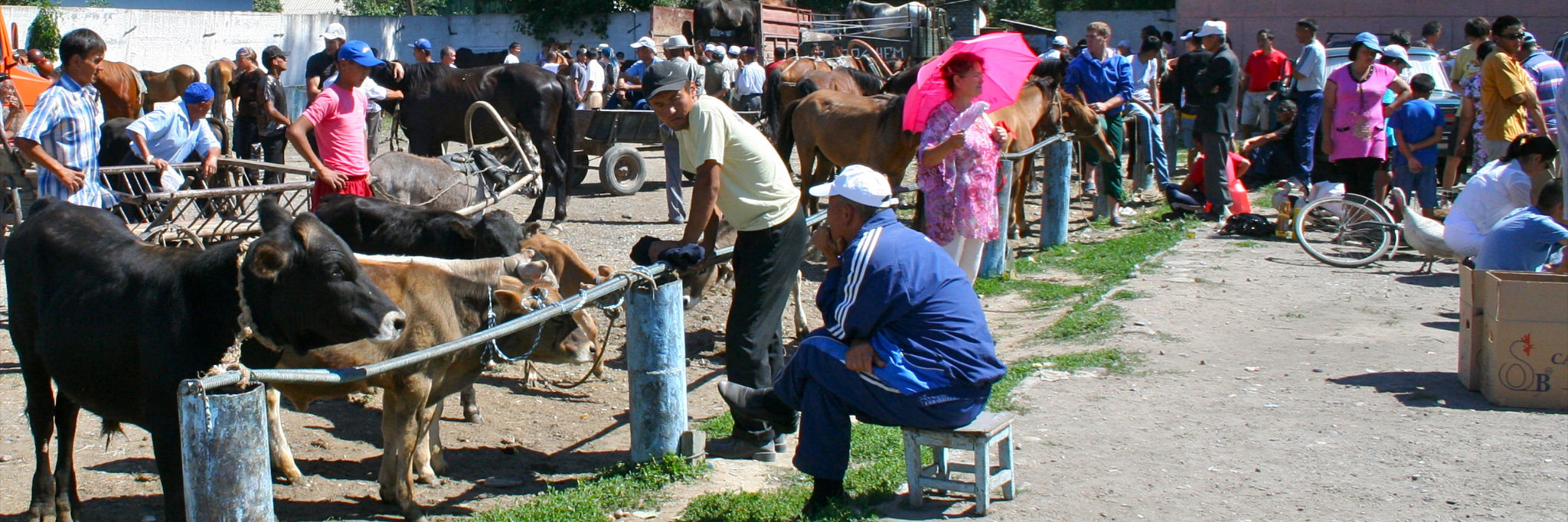
Regionally, the focus at Chair ‘Economic Anthropology’ is on Central and Inner Asia, a vast area in the middle of the Eurasian landmass. With currently three postdoctoral researchers and five (soon seven) PhD students, this is the largest aggregation of anthropologists working on this region in Europe.
Central Asia, defined in a broad sense, encompasses the former Soviet republics of Kyrgyzstan, Qazaqstan, Tajikistan, Turkmenistan, and Uzbekistan, as well as the Autonomous Region of Xinjiang in China, and the Mongolian and Tibetan areas further east. Throughout its history, the region has been a meeting place and a transition zone of economic goods, cultural ideas and political mobilisations. Following the end of socialism, people in Central Asia have experienced dramatic changes that also created a new type of global integration. In popular imagination, this is often linked to scenarios of ethnic conflicts, ecological crises and social disruptions, aggravated by its geo-political location in-between Russia, China, and the Middle East. On the ground, however, the situation shows a much more complex and variable picture.
Research at the chair take place on a broad range of topics, from economic transformation in rural areas and the concomitant adaptive strategies households seek to implement to the effects of climate change, internal and global migration patterns, forms of identity and inter-ethnic relations, as well as socio-political processes and governance on the ground.
In terms of teaching, this strong focus enables students to participate in multiple research activities and projects. On average every two years we also offer an excursion or summer school in the region that provides students the opportunity to gain first hand insights and the chance to conduct individual projects.