
Project Design
TEMP MIGRATION dialogues with several separate approaches at the intersection of migration theories, anthropology of labor, and research on belonging and place-making amid demographic and socio-cultural change. The research design is inspired by the framing perspective of migration regimes, which govern labor migration differently due to the way they have developed structurally and historically. That said, democratic capitalist states globally demonstrate a common trend: temporary migration has become an increasingly important tool for filling labor market needs in systematically important industries, three of which are examined in this project. These are the IT sector, health care, with a focus on nursing, and manual construction labor.
As another commonality across migrant-labor importing regimes, there exists a differential allocation of migrants’ rights along socially constructed skill levels. Rights are granted on basis of migrants’ presumed contribution to the country and are thus differentiated by a hierarchy of ‘skills’. The hierarchies between occupational sectors often also intersect with gender and race, as is the case with the three sectors in focus of this project: Construction, which is synonymous with male migrant workers, often from the Global South; nursing, positioned as a skilled occupation but located within the broader health care sector with often more ambiguous ascriptions of skills, and stereotyped as ‘female’; and high-tech professions in IT, where the image of corporate expatriates as supposedly male, from the Global North, and racialized as ‘white’ has recently been changing.
Linking the above is the project’s focus on people’s place-making and belonging as expressed through their daily practices and concerns. While we primarily focus on temporary labor migrants’ perspectives (in-depth interviews), we also conduct ethnographic observations at migrants’ workplaces and participant observation at events of migrants’ social networks and migrant communities. Our goal is to elucidate the meaning temporary migrants attach to shared space, belonging, and their futures in rapidly diversifying and aging democratic societies that rely on temporary labor migration.
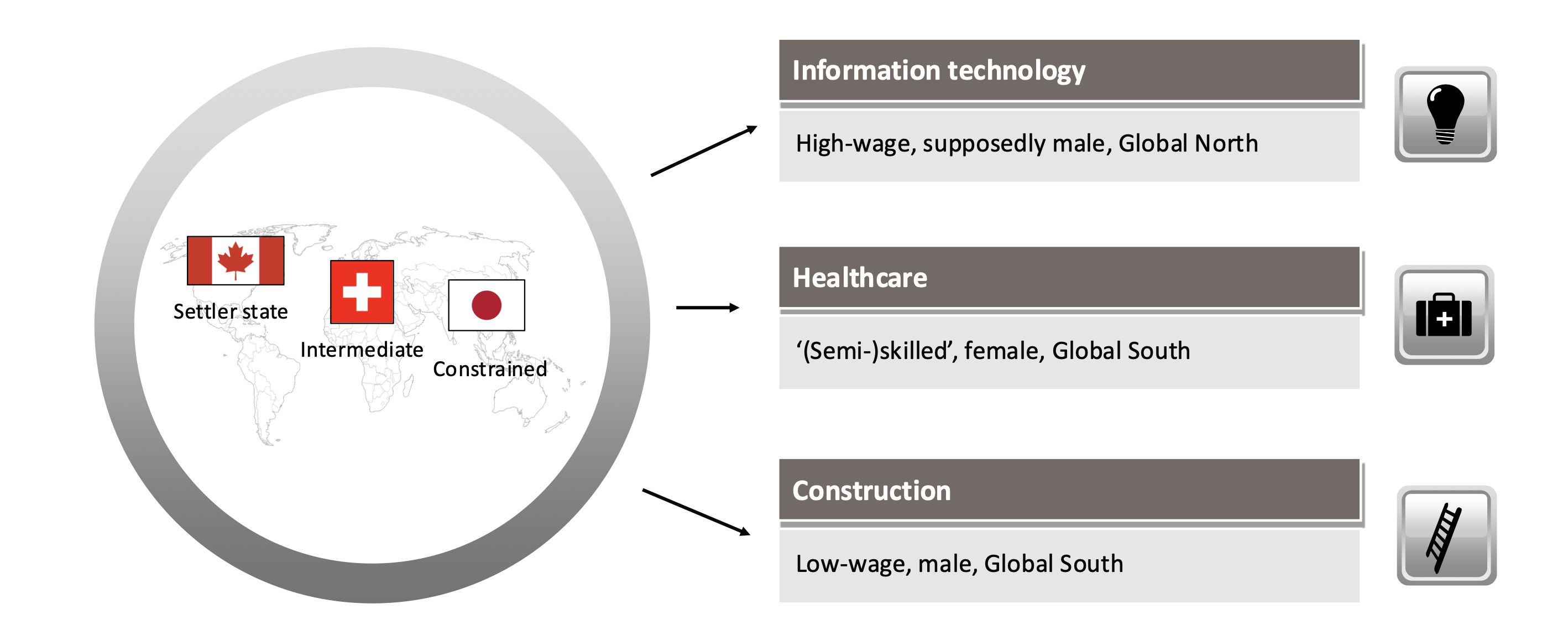
To provide a holistic picture, TEMP MIGRATION examines Canada as a previous settler state and contemporary “Neoliberal Regime” – with high levels of immigration and expedited access to citizenship –, Switzerland, with elevated levels of free movement inside the European Union but limited pathways to citizenship as an intermediate, “Intra-Union Regime”, and Japan, with lower levels of migration and naturalization as a “Constrained Regime”. Despite the three countries' differential allocation along a continuum of regulating temporariness and granting permanence, scholarship has demonstrated significant changes in recent years. Thus, the comparative analysis will help reveal if temporariness is a more generalizable experience across different regimes.